Depth-guided Multi-view Exposure Bracketing for HDR Robot Vision

Jinnyeong Kim, Juhyung Choi, Woohyeok Kim, Sunghyun Cho, Seung-Hwan Baek
POSTECH
ECCV 2026  ·  Datasets and Benchmarks
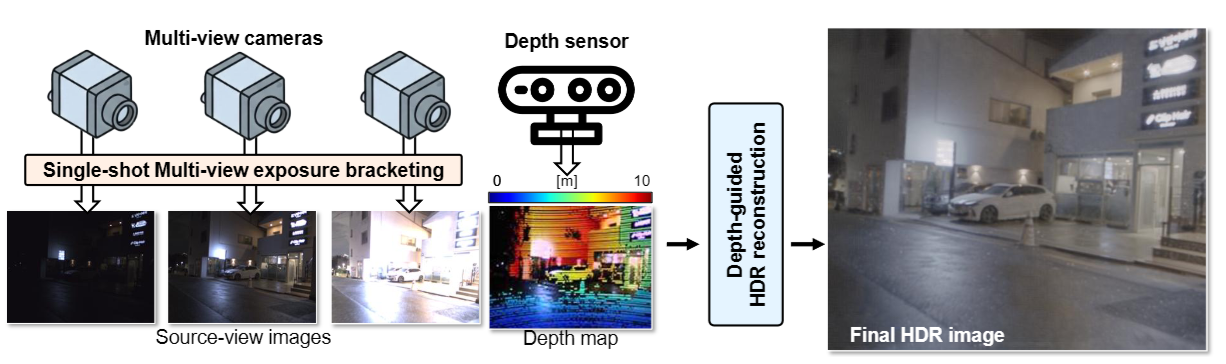
Single-shot multi-view exposure bracketing with depth-guided HDR reconstruction

Single-shot, multi-view exposure bracketing with a depth sensor, fused by a depth-guided reconstruction into a clean HDR image — captured across a robot rig, an iPhone, and a CARLA generator.

Abstract

High dynamic range (HDR) reconstruction is fundamental to robust vision under extreme lighting, yet existing datasets capture either a single view or a single exposure regime, leaving multi-view, varying-exposure settings unexplored. We present a multi-view, varying-exposure HDR benchmark for robot and consumer vision. It spans a calibrated robot acquisition rig (with LiDAR, active-stereo, and iToF depth), an iPhone, and a CARLA-based synthetic generator that reaches dynamic ranges hardware cannot easily produce.

The benchmark enables evaluation regimes prior HDR datasets could not support: synchronized multi-view varying exposures, depth-guided HDR reconstruction, and controlled ablation over camera count and depth modality. As a reference pipeline, we provide DMEB (Depth-Merged Exposure Bracketing), which fuses depth-warped multi-view observations into an HDR reconstruction in the reference-camera field of view. All four data subsets, the benchmark protocol, the reference code, and model weights are publicly released.
The Benchmark

Four subsets, all publicly released as a processed benchmark release (synchronized, calibrated, undistorted). Raw ROS bags / raw sensor streams are not included.

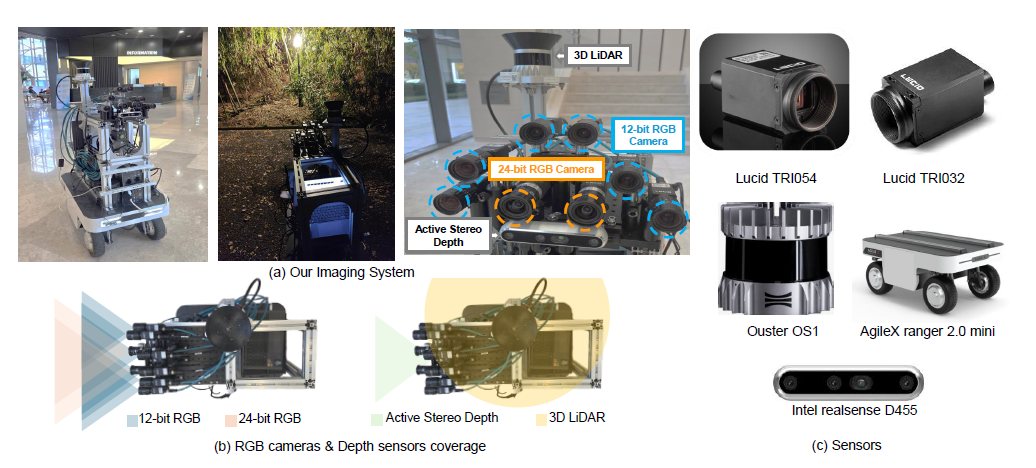
Robot vision acquisition system: cameras, depth sensors, coverage
Robot acquisition system: synchronized RGB cameras (12-bit and 24-bit HDR reference) with LiDAR, active-stereo, and iToF depth.
SubsetSensors / InputsHDR GTDepthDownload
Robot — Modest DR 3 cameras × 2 exposures (TIFF), HDR reference cam (EXR) depth-registered EXR LiDAR + active-stereo + iToF Google Drive
Robot — Ultra DR single-shot LDR (EXR) burst-based EXR LiDAR + active-stereo Google Drive
Synthetic — CARLA rendered multi-view LDR (EXR) rendered EXR (extreme DR) metric + sensor-like Google Drive
iPhone wide / ultrawide / telephoto bracket-generated LiDAR Google Drive

The full dataset root is available on Google Drive. Each subset ships with intrinsics/extrinsics, per-frame timestamps, per-camera exposure/gain, valid masks, and scene metadata. See the dataset card, data format, and benchmark protocol. A MANIFEST.md5 with checksums accompanies every archive.

Reference Pipeline: DMEB

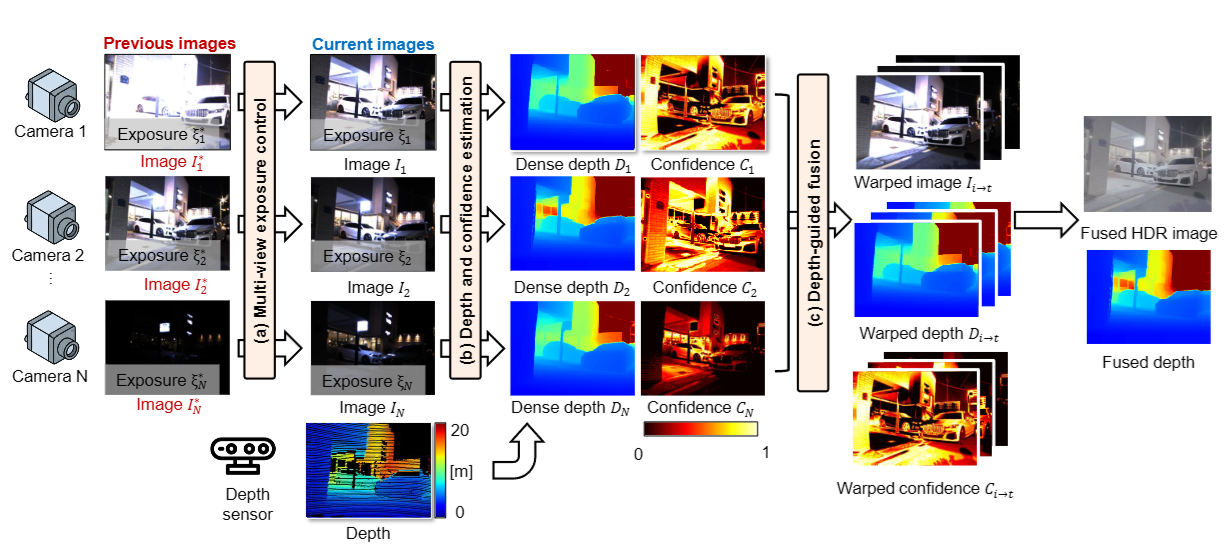
DMEB (Depth-Merged Exposure Bracketing) is the benchmark's reference method. It warps multi-view, varying-exposure observations with the depth sensor, estimates per-view confidence, and fuses them into HDR radiance in the reference-camera field of view.

DMEB pipeline: exposure control, depth and confidence, warping, fusion

Benchmark Results

PSNR (dB) on the robot held-out evaluation set. The benchmark separates the gain from the capture setting (single-shot multi-camera) from the gain of the DMEB model. Metrics are computed in the linear HDR domain over the reference-camera field of view.

MethodMulti-shot single-cameraSingle-shot multi-camera
HDR-Transformer31.2633.61
AFUNet29.6432.25
DMEB (reference)30.7239.40

Cross-platform generalization (PSNR, dB):

MethodiPhoneChoi et al. (zero-shot)
HDR-Transformer23.3526.33
AFUNet25.2125.39
DMEB (reference)26.1233.00

Depth-modality ablation enabled by the benchmark (DMEB, PSNR dB): optical flow 35.84 → monocular 37.09 → mono + LiDAR (single-view) 37.90 → mono + LiDAR (multi-view) 39.40.

iPhone is reported as a consumer proof-of-concept (evaluated on the common-overlap region with valid masks); Choi et al. results are zero-shot. See the paper for full protocol.

Code & Reproduction

The reference pipeline (inference + evaluation + checkpoint) reproduces the main table. Minimal example:

cd code
pip install -r requirements.txt

python inference.py --data_root /path/to/robot_modest_dr \
                    --ckpt /path/to/dmeb_ref.pth --output out/
python eval.py --pred out/ --gt /path/to/robot_modest_dr

Full instructions: code/README.md.

BibTeX

@inproceedings{kim2026dmeb,
  title     = {Depth-guided Multi-view Exposure Bracketing for HDR Robot Vision},
  author    = {Kim, Jinnyeong and Choi, Juhyung and Kim, Woohyeok and Cho, Sunghyun and Baek, Seung-Hwan},
  booktitle = {European Conference on Computer Vision (ECCV)},
  year      = {2026}
}