Stage 1
RGB initialization
Initialize object geometry from multi-view RGB images under natural ambient lighting.
SIGGRAPH Conference Papers 2026
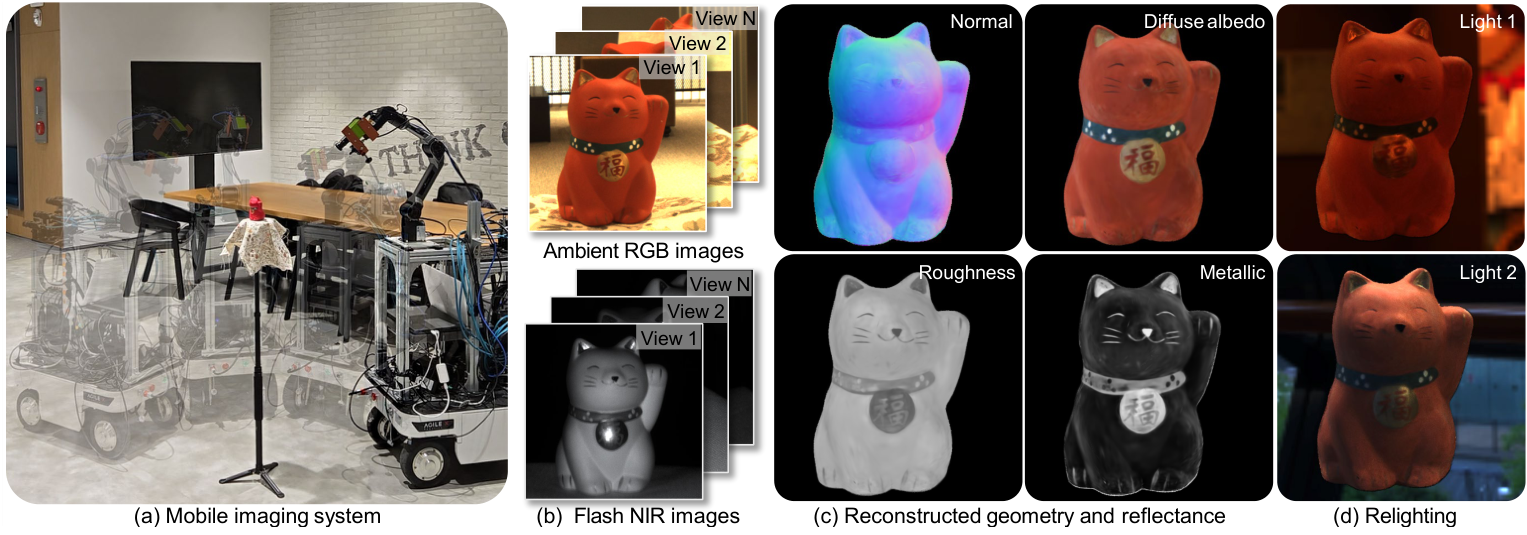
We introduce an active RGB-NIR imaging system and a three-stage inverse rendering pipeline that reconstructs accurate geometry and reflectance under diverse ambient illumination.
POSTECH · *Equal contribution
Overview
Existing inverse rendering methods can be sensitive to uncontrolled ambient lighting. This project uses imperceptible NIR flash illumination to obtain stable point-light shading, while RGB images preserve visible-spectrum appearance for downstream rendering.
The method combines multi-view RGB observations, active NIR flash images, and an RGB-NIR BRDF model to recover geometry, roughness, metallic parameters, diffuse albedo, and environment illumination.
Pipeline
The pipeline proceeds in three stages: RGB-based geometry initialization, NIR flash inverse rendering for robust geometry and reflectance refinement, and RGB environment inverse rendering for visible diffuse albedo and illumination recovery.
Stage 1
Initialize object geometry from multi-view RGB images under natural ambient lighting.
Stage 2
Use flash-only NIR measurements to refine geometry and estimate NIR reflectance.
Stage 3
Recover RGB diffuse albedo and ambient environment maps using the refined reconstruction.
System
The acquisition platform combines a mobile base, robotic arm, pixel-aligned RGB-NIR camera, and synchronized NIR flash. The system scans objects from dense viewpoints while keeping NIR illumination largely invisible to human observers.
Dataset
The dataset contains multi-view RGB-NIR image pairs with active NIR flash under multiple ambient illumination conditions, together with a synthetic counterpart rendered to match the acquisition setup.
Four objects and fourteen ambient scenes, shown as pixel-aligned RGB/NIR preview pairs.
14 assets
Three synthetic objects and four ambient scenes, shown as RGB/NIR preview pairs.
12 assets
Results
The following synchronized clips show the recovered material components and environment-conditioned relighting for three synthetic objects and three real-world objects. Each scene is a 12-second result sequence that loops continuously like an animated figure.
Synthetic
Controlled synthetic scenes expose the recovered reflectance decomposition and relighting behavior across different object geometries.
Real world
Real captures demonstrate reconstruction and relighting on objects with measured RGB-NIR observations under changing ambient environments.
Real world
Reconstructed real-world objects rendered under changing point-light illumination to visualize the recovered appearance and material response.
Citation
@inproceedings{chung2026ambient,
  title     = {Ambient-robust Inverse Rendering using Active RGB-NIR Imaging},
  author    = {Chung, Hoon-Gyu and Kim, Jinnyeong and Kang, Hyunwoo and Baek, Seung-Hwan},
  booktitle = {SIGGRAPH Conference Papers},
  year      = {2026},
  doi       = {10.1145/3799902.3811078}
}